
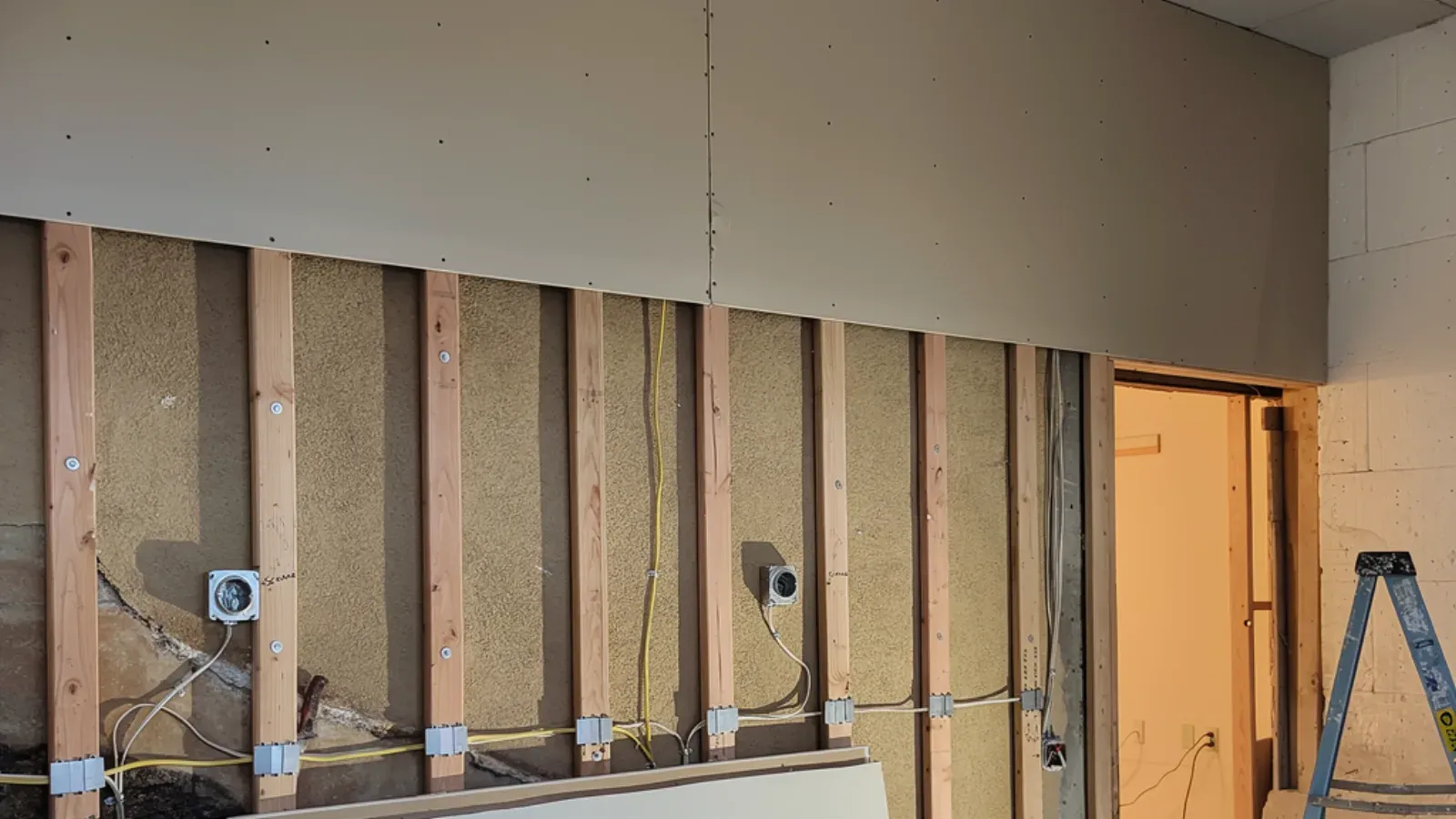
Signs you need this
- • A newly framed room addition, attic conversion, or bumped-out kitchen is studded and wired but still open to the framing, waiting on walls and ceilings
- • A gutted room down to the studs after a renovation or a plaster tear-out, with nothing to paint or trim to
- • A finished basement or mill-loft space where the framing is up but the space is unusable until it's boarded and finished
- • A general contractor or homeowner has framing inspected and signed off and now needs board hung and finished to a paintable state
- • Framing and rough inspections (electrical, plumbing, insulation) have passed and the job is ready to close in the walls
- • A homeowner acting as their own GC on an addition realizes hanging and finishing drywall well is a separate trade from framing it
From Bare Framing to a Paintable Wall
Hanging drywall well is a different trade from framing the wall behind it. Lowell Quality Drywall & Plaster takes a room from inspected framing to a flat, primed-ready surface: board measured and cut to fit, fastened to studs and joists on the right screw schedule, seams staggered so no joint lines up floor to ceiling, and outside corners protected with corner bead. The hang decides how good the finish can be. Boards butted tight with fasteners set just below the paper, not blown through it, give the taper a clean surface to work with. A sloppy hang shows through even the best mud job, so the crew treats the hang as the foundation of the finish, not a step to rush past.
New Construction, Additions, and Conversions in Lowell
Most installation work in Lowell falls into a few buckets. A room addition or dormer in Belvidere or South Lowell adds new framed space that needs boarding wall and ceiling. An attic conversion in a Pawtucketville cape turns unfinished space into a bedroom or office. And downtown, the Boott, Massachusetts, and Appleton mill buildings and other loft conversions need new partition walls to carve open floor plates into rooms. Lowell Quality Drywall & Plaster handles each: hanging and finishing on framing a contractor built, or framing the partition first in wood or light-gauge steel and then boarding it. Because so much of Lowell’s original housing is lath-and-plaster, new drywall in an addition often has to blend to old plaster in the existing rooms, which is a finish-matching problem the crew solves with a skim coat at the transition.
Choosing the Right Board
Board is not one product. Standard ½″ sheetrock handles most walls. Ceilings and wide spans usually get ⅝″ board because it resists the sag that thinner board develops overhead, especially under blown insulation. Where a rated assembly is required, such as an attached-garage addition or a demising wall between units in a two-family, ⅝″ Type X goes up to hold the fire rating. A new bathroom inside an addition gets moisture-resistant board on the wet walls. Lowell Quality Drywall & Plaster matches board type and thickness to the location and the Massachusetts State Building Code (780 CMR), using USG Sheetrock, National Gypsum Gold Bond, CertainTeed, and Georgia-Pacific ToughRock depending on the application, all manufactured to ASTM C1396.
Level 4 Versus Level 5, and Why It Matters
The finish level, defined by the Gypsum Association’s GA-214 standard, sets how much mud work the seams get. A Level 4 finish, the default for most painted walls, coats the tape and fasteners smooth and reads flat under normal room lighting. A Level 5 finish adds a thin skim coat over the entire surface, which matters where light rakes across a wall, near large windows, on walls getting gloss or semi-gloss paint, or in open sightlines where a Level 4 can let seams telegraph. Lowell Quality Drywall & Plaster recommends the level that fits the room’s lighting and paint, rather than defaulting to the cheapest finish and letting the seams show up after the painters leave.
Staying on the Critical Path
Drywall sits at a pinch point in any build. Paint, trim, cabinets, and flooring all wait on finished walls, so a slow or sloppy drywall stage holds up every trade behind it. Lowell Quality Drywall & Plaster schedules a hang and finish to keep the project moving, coordinating with the general contractor or the homeowner acting as their own GC so the mud has time to dry between coats without stalling the whole job. On a room addition that means the walls are ready for the painter on the promised day, not a week late.
Materials & standards
Products & materials we use
- USG Sheetrock
- National Gypsum Gold Bond
- CertainTeed
- Georgia-Pacific ToughRock
- ⅝″ Type X
Standards & codes we work to
- Massachusetts State Building Code (780 CMR)
- ICC/IBC
- ASTM C1396
- GA-214 finish levels (Level 0–5)
- MA Construction Supervisor License (CSL)
- MA Home Improvement Contractor (HIC) registration
What the terms mean
- hang and finish
- metal-stud (light-gauge) framing
- taping and mudding
- corner bead
- screw schedule
- Level 4 finish
- Level 5 skim coat
- ⅝″ Type X
- joint compound
- FibaTape
Options & variants
| Option | When it applies | Cost |
|---|---|---|
| Hang and finish on existing framing | Framing is done and inspected; crew boards and finishes only | Baseline, driven by square footage |
| Frame, hang, and finish | New partition wall needs building first (wood or light-gauge steel) | Higher, adds framing labor and material |
| Room addition or attic conversion | Whole-room board and finish on a new structural space | Larger scope, priced by total wall and ceiling area |
| Ceiling drywall | Hanging overhead board, often ⅝″ for sag resistance on wide spans | Slower hang, more labor per square foot |
What affects cost
- • Total square footage of wall and ceiling being boarded, which is the main driver on a new-construction or addition job
- • Whether framing already exists and is inspected, or the crew has to build partition walls first
- • Ceiling work versus wall work: overhead board is slower to hang and often calls for thicker ⅝″ board to resist sag
- • The finish level required, a standard Level 4 for painted walls versus a Level 5 skim for spaces with critical lighting or gloss paint
- • Board type: standard sheetrock, ⅝″ Type X where a rated assembly is required, or moisture-resistant board in a bathroom within the addition
- • Access and height: tall stairwell walls, cathedral ceilings, and tight mill-loft conversions take more staging and time
What to expect
- 1
Walkthrough and measure
The crew reviews the framing, confirms inspections are passed, and measures total wall and ceiling area to scope the board count and finish level.
- 2
Framing check or build
If a new partition is part of the job, it's framed in wood or light-gauge steel and squared before board goes up.
- 3
Hang
Board is measured, cut, and fastened to studs and joists on the correct screw schedule, with seams staggered and outside corners set with corner bead.
- 4
Tape and mud
Seams and fasteners are taped and coated in successive passes, building the joint compound out flat.
- 5
Sand and finish
Seams are sanded to the agreed finish level, Level 4 standard or Level 5 skim where the lighting demands it, and left primed-ready.
- 6
Walkthrough
The finished surface is checked under work light for flat seams and clean corners before paint and trim follow.
When this isn’t the right call
- If the walls are existing lath-and-plaster that's cracking or failing rather than new framing to board, plaster repair and plaster-to-drywall conversion is the better fit.
- If the job is finishing a below-grade basement with moisture and framing-off-masonry concerns, basement drywall finishing is the better fit.
- If the framing is already boarded and only needs taping and finishing, drywall taping and finishing is the better fit.
Frequently asked questions
Do you hang drywall on framing I've already built, or do you frame it too? +
Both. Lowell Quality Drywall & Plaster will hang and finish on framing that's already up and inspected, or frame a new partition wall in wood or light-gauge steel first and then board it. Just say which you need when you call.
What finish level should I ask for? +
Most painted walls are finished to a Level 4, which is smooth under normal lighting. A Level 5 skim coat is worth it for walls under raking window light, near sidelighting, or getting a gloss or semi-gloss paint, where a Level 4 can telegraph seams.
Can you drywall a room addition or attic conversion start to finish? +
Yes. Once the framing and rough inspections pass, Lowell Quality Drywall & Plaster boards the whole space, walls and ceilings, tapes and finishes it, and leaves it primed-ready for paint and trim.
Do you use ⅝″ or ½″ board? +
It depends on the location. Ceilings and wide spans usually get ⅝″ to resist sagging, walls are typically ½″, and any rated assembly like a garage or a demising wall between units gets ⅝″ Type X. The crew matches board thickness to the code and the span.
Will my new drywall match the finish in the rest of the house? +
If the addition ties into existing rooms, the crew matches the surrounding texture and finish level so the transition doesn't stand out. In older Lowell homes with plaster in the original rooms, that can mean a skim finish to blend the new drywall to the old plaster feel.
How long does a room's worth of drywall take? +
A single room is usually a few days: a day to hang, then taping and finishing over the following days with drying time between mud coats. Larger additions and multi-room jobs are scheduled to keep the overall project moving toward paint.