
Signs you need this
- • Every footstep, TV, and conversation carries through the wall or ceiling from the next unit in a triple-decker or a converted condo
- • A shared party wall between two units where you can hear a neighbor's voice clearly enough to follow the conversation
- • A home office, nursery, or bedroom that sits against a noisy wall and never feels quiet no matter how the room is arranged
- • A mill-loft condo with hard surfaces and thin partitions where sound bounces and travels between spaces
- • A new tenant or owner who moves into a triple-decker unit and realizes the noise from the neighboring unit is unlivable
- • A homeowner finishing a basement, building a home office, or setting up a nursery who wants that room genuinely quiet before the walls close up
Soundproofing Is a System, Not a Thicker Wall
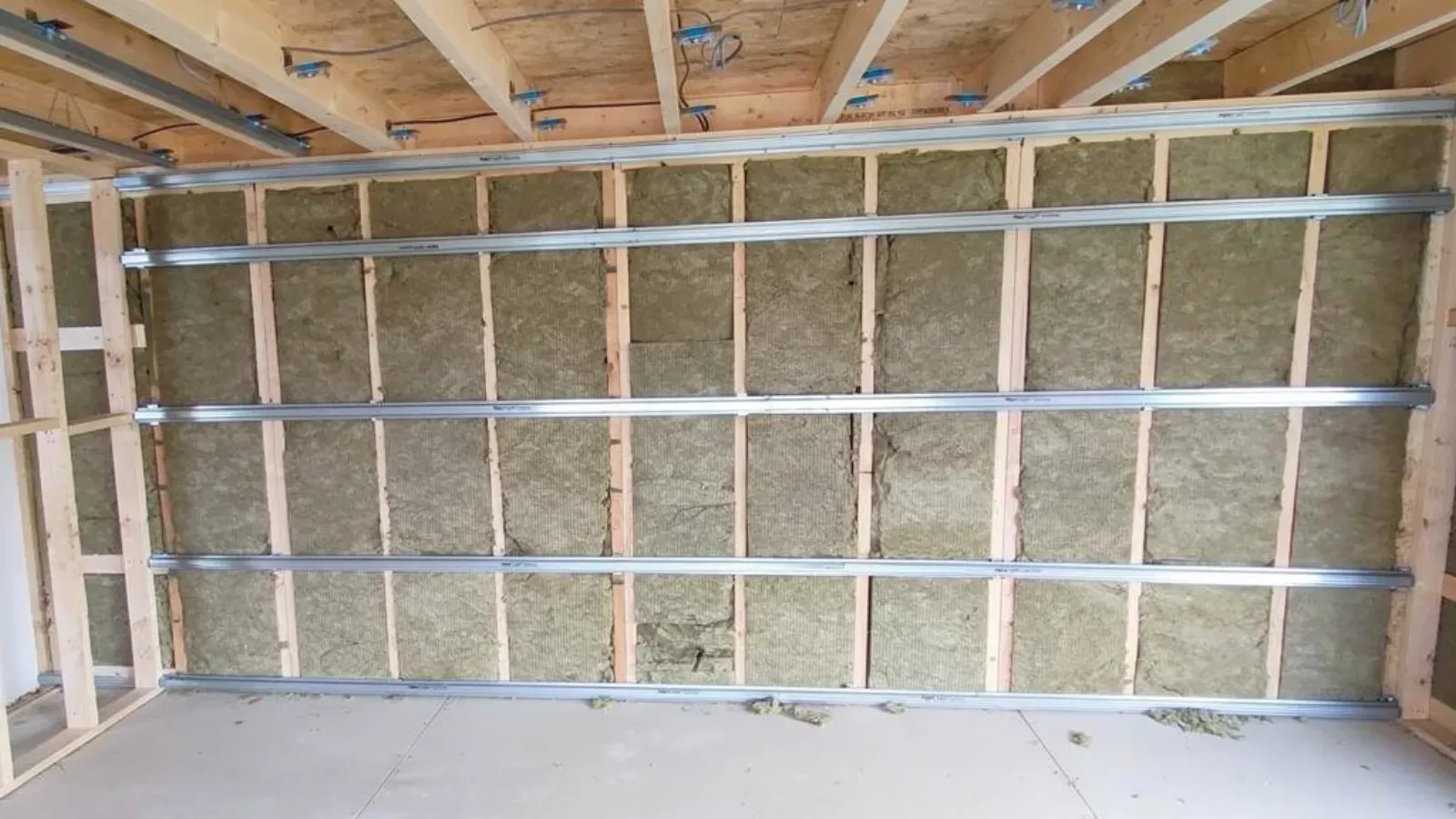
The most common misconception about a quiet wall is that it’s just a heavier one. Adding a layer of board helps a little, but real soundproofing is an assembly working together, and every piece has a job. Lowell Quality Drywall & Plaster builds to a target STC, or Sound Transmission Class, the rating that measures how well a wall blocks airborne sound, so the result is measured performance rather than a guess. That assembly combines sound-damping board (QuietRock, or a double layer of standard board with Green Glue damping compound sandwiched between the sheets), resilient channel or isolation clips that break the path vibration travels through the framing, an insulated cavity, and airtight sealing at every edge and penetration. Leave any one of those out and the wall underperforms, because sound, like water, finds the weakest point in the assembly and pours through it.
Why Lowell’s Triple-Deckers and Mill Lofts Need It
Lowell was built dense. The city’s enormous stock of triple-deckers and two-families puts households on top of and next to each other, sharing party walls and floor-ceiling assemblies that were never built to modern sound standards. A neighbor’s television, footsteps, and conversation carry straight through. Downtown, the Boott, Massachusetts, and Appleton Mills conversions turned 19th-century mills into loft condos, where hard surfaces and shared partitions let sound bounce and travel between units. Add the student rentals around UMass Lowell, where noise between units drives complaints, and sound isolation becomes a genuine, recurring need across the city, not a luxury upgrade. Lowell Quality Drywall & Plaster builds party-wall and floor-ceiling assemblies that cut that transfer, matched to whether the goal is a quieter bedroom or a wall that keeps a neighbor’s voice out entirely.
Party Walls That Also Have to Be Fire-Rated
A wall separating two units in a triple-decker or a condo is a demising wall, and in most cases it has to be fire-rated under the Massachusetts State Building Code (780 CMR) as well as quiet. Those two goals are built together, not in sequence. Lowell Quality Drywall & Plaster constructs a single assembly that uses Type X board to meet the UL fire rating and layers it with the sound-isolation methods (resilient channel, a second board layer, Green Glue, an insulated cavity) that bring the STC up at the same time. Getting both from one correctly built assembly is what separates a demising wall that just passes inspection from one that also makes the unit livable.
Airborne Noise Versus Footsteps
Not all noise travels the same way, and the fix differs. A neighbor’s voice or television is airborne sound, which moves through the wall assembly and is handled by the mass, damping, and isolation in that wall. Footsteps and thumps from the unit above are impact noise, which travels through the floor-ceiling structure itself, a different path entirely. Working only on the walls won’t quiet a heavy walker upstairs. Lowell Quality Drywall & Plaster addresses impact noise by treating the ceiling assembly, isolating it with resilient channel or clips and adding mass, so the solution matches the actual path the noise is taking rather than the one that’s easiest to reach.
Retrofit Versus Building It In
The best time to soundproof a wall is while it’s open, during a renovation or a new partition, because the highest-performing methods depend on what goes inside and behind the board: the insulation, the resilient channel, the sealed cavity. When a wall is already finished, Lowell Quality Drywall & Plaster can still improve it with a retrofit, adding a layer of QuietRock or a second board layer with Green Glue over the existing surface, which meaningfully reduces transfer without a full tear-out. The honest tradeoff is that a retrofit reaches a lower ceiling than an assembly built from the studs out, and the company sets that expectation up front so an owner knows what a given approach can and can’t deliver.
Materials & standards
Products & materials we use
- QuietRock
- Green Glue
- USG Sheetrock
- National Gypsum Gold Bond
- Type X board
- resilient channel
Standards & codes we work to
- STC (Sound Transmission Class)
- Massachusetts State Building Code (780 CMR)
- UL fire-rated assemblies
- ASTM C1396
- MA Construction Supervisor License (CSL)
- MA Home Improvement Contractor (HIC) registration
What the terms mean
- soundproofing
- sound-damping board
- resilient channel
- isolation clips
- double-layer assembly
- Green Glue damping compound
- demising wall
- party wall
- fire-rated assembly
- acoustic insulation
Options & variants
| Option | When it applies | Cost |
|---|---|---|
| QuietRock sound-damping board | A retrofit or new wall where a high-performing single-panel solution is wanted with less buildup | Higher board cost, faster install, less wall thickness added |
| Double-layer with Green Glue | Maximum sound blocking where wall thickness allows two layers of board | Moderate material cost, added labor for the second layer |
| Resilient channel or isolation clips | Breaking the vibration path through the framing on a wall or ceiling | Adds framing labor, significantly improves performance |
| Full party-wall or demising assembly | Separating two units in a triple-decker or condo, often also fire-rated | Higher, a complete rated and sound-isolated assembly |
What affects cost
- • The STC target: a modestly quieter bedroom is a different assembly than a party wall built to keep a neighbor's voice out entirely
- • Whether the wall is open (new construction or a renovation) or has to be retrofitted over an existing finished wall, which limits which methods fit
- • The method chosen, since QuietRock, a double layer with Green Glue, and resilient channel each carry different material and labor
- • Whether the assembly also has to be fire-rated, which is common for a demising wall between two units and adds Type X board and rated-assembly requirements
- • The area involved and whether it's a wall, a floor-ceiling assembly (which involves the structure above), or both
What to expect
- 1
Talk through the goal
What sound is the problem (voices, footsteps, TV), which wall or ceiling, and how quiet the space needs to be, since that sets the STC target and the assembly.
- 2
Assess the wall
Whether it's open or finished, how the framing is built, and whether a demising wall also needs to be fire-rated, all of which decide which methods fit.
- 3
Build the assembly
Insulate the cavity, install resilient channel or isolation clips where called for, and hang QuietRock or a double layer with Green Glue between the sheets.
- 4
Seal every gap
Perimeter, outlets, and penetrations are sealed airtight, since a soundproof wall leaks sound through any gap the way a boat leaks through any hole.
- 5
Finish and blend
The wall is taped, mudded, and finished to match the surrounding surface, so the soundproofing is invisible once it's painted.
When this isn’t the right call
- If the wall just needs to separate two units for fire safety without a specific sound goal, a standard fire-rated assembly is the better fit, though the two are often combined on a demising wall.
- If the noise is coming through windows, doors, or gaps rather than the wall assembly, sealing those openings comes first, since drywall can't fix a sound path it doesn't cover.
- If the wall is already finished and the owner only wants a light improvement without opening it up, a full-performance assembly isn't possible without access, and expectations should be set accordingly.
Frequently asked questions
What actually makes a wall soundproof? +
Not thickness alone. Real soundproofing is a system: sound-damping board like QuietRock or a double layer with Green Glue between the sheets, hung on resilient channel or clips that break the vibration path through the framing, with an insulated cavity and every gap sealed airtight. Lowell Quality Drywall & Plaster builds the whole assembly, because any one piece alone underperforms.
What is STC and what number do I need? +
STC, or Sound Transmission Class, rates how well an assembly blocks airborne sound; a higher number blocks more. A quiet bedroom wants a moderate rating, while a party wall meant to keep a neighbor's voice out entirely needs a high one. Lowell Quality Drywall & Plaster sets the target with you and builds the assembly that reaches it.
Is QuietRock worth it, or should I use a double layer of regular board? +
Both work, and the right choice depends on the wall. QuietRock is a single sound-damping panel that adds less thickness and installs faster, good for retrofits. A double layer of standard board with Green Glue between the sheets can reach a very high rating where the wall thickness allows two layers. Lowell Quality Drywall & Plaster recommends whichever fits the wall and the goal.
Can you soundproof a party wall in a triple-decker between two units? +
Yes, and it's common Lowell work. A party wall between units usually also has to be fire-rated, so the assembly is built to both block sound and meet the fire-rating requirement at once, using Type X board within the rated soundproof assembly.
Can you soundproof a wall that's already finished, without tearing it open? +
Partly. The highest-performing methods rely on what goes inside and behind the board, so a fully finished wall limits the options. A retrofit can still add a layer of QuietRock or a second board layer with Green Glue over the existing surface, which helps, but the best results come when the wall is open during a renovation.
Will soundproofing stop footstep noise from the unit above? +
Footstep noise travels through the floor-ceiling structure, which is a different path than airborne voice through a wall. It's addressed by treating the ceiling assembly, isolating it with resilient channel or clips and adding mass, rather than by working only on the walls. Lowell Quality Drywall & Plaster handles the ceiling assembly when impact noise from above is the problem.