
Signs you need this
- • Walls that look fine flat-painted but show every roller mark, seam, and old patch the moment low sunlight or a wall sconce rakes across them
- • A rough, sandy, or uneven surface left after wallpaper came down, old texture was scraped, or a plaster wall was patched in a dozen places over the years
- • Glossy or satin paint that highlights every ripple and joint because the wall underneath was only finished to a builder-grade standard
- • A downtown mill-loft or new addition where the client wants the flat, seamless modern look and the existing board only got mud on the seams
- • A homeowner repainting in a modern flat or high-sheen color who realizes the wall's imperfections will show through no matter how good the paint is
- • A Belvidere homeowner tired of a patchwork plaster wall who wants one continuous smooth surface instead of a map of old repairs
What a True Flat Wall Actually Takes
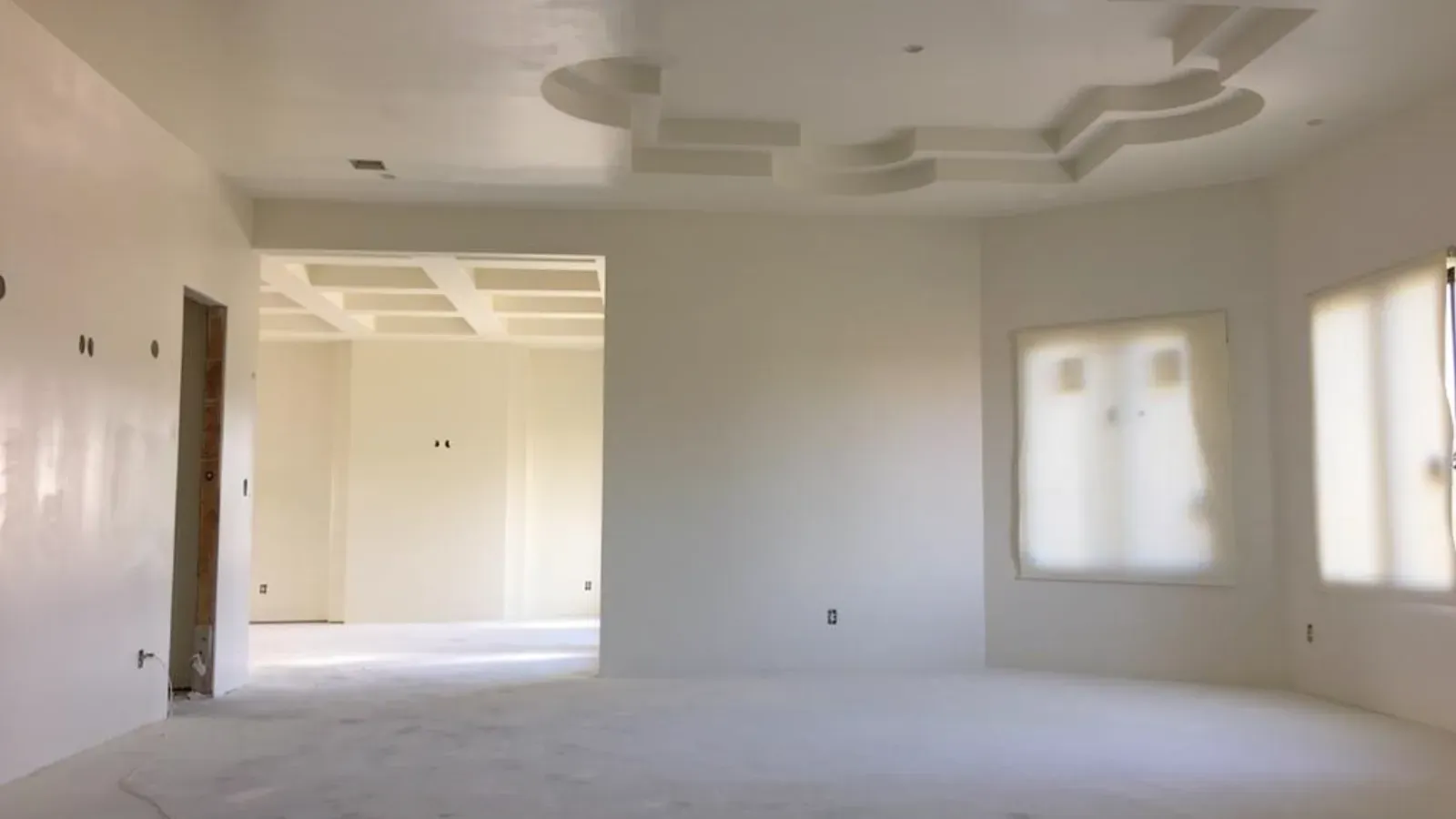
Most walls are finished to what the trade calls a Level 4: the seams and fastener heads are taped and coated, and everything in between is left as the bare face of the board. Under ordinary paint and ordinary light, that looks fine. Under flat paint, high-gloss paint, or the low raking light from a window or a wall sconce, the difference between a coated seam and the untouched field of the board shows up as a faint shadow line running down the wall. Lowell Quality Drywall & Plaster closes that gap by skimming the entire surface, so the whole plane is one continuous coat of joint compound instead of smooth only where the seams are. That full-surface skim is what the GA-214 standard calls a Level 5 finish, and it is the finish that makes demanding paint and demanding light look flawless.
Resurfacing an Old Wall Versus Finishing a New One
Skim coating solves two different problems in Lowell’s housing. On new board, in an addition or a gut renovation, it upgrades a builder-grade Level 4 to a Level 5 before the painters arrive. On old walls, it resurfaces. A great deal of Lowell’s stock is original lath-and-plaster, and after a century of patches, wallpaper, and repaint, those walls are often still structurally sound but rough, uneven, and mapped with old repairs. Rather than tear all of that out, Lowell Quality Drywall & Plaster skims over the sound plaster to bring it back to one smooth, continuous surface. That saves the mess and cost of a full tear-out and keeps the original wall in place, which matters in Belvidere’s older homes and in the mill-loft conversions downtown where owners want a clean modern surface without gutting the building’s bones.
Why Downtown Mill Lofts Ask for This
The Boott, Massachusetts, and Appleton Mills conversions turned Lowell’s 19th-century mills into loft condos, and loft living leans on flat, gallery-white walls that read as intentional. A big window wall, high ceilings, and hard side light are exactly the conditions that expose a lesser finish. Lowell Quality Drywall & Plaster brings those surfaces to a Level 5 so the light that makes a loft feel open doesn’t also make every seam and ripple stand out. The same logic applies to any Lowell home repainting in a modern flat color, where the paint that looks so clean on the chip will also show every flaw the wall hides underneath.
The Coats, the Sanding, and the Light
A skim and Level 5 finish is a layered process, not a single pass. A thin coat of joint compound goes over the full surface, dries, and is sanded flat. A second thin coat follows, and often a third, each one drying and getting sanded before the next. The drying time between coats is fixed, which is why even a single room takes a few days: the work can’t be rushed without trapping soft compound under a hard shell that cracks later. The final check happens under raking light, a work light held low and close to the wall, because that angle reveals any remaining ripple that ordinary front light would hide. Only once the plane reads true under that light does Lowell Quality Drywall & Plaster prime the surface and hand it off ready for paint.
Matching Board and Compound to the Job
The finish is only as good as the materials feeding it. Lowell Quality Drywall & Plaster works with standard USG Sheetrock, National Gypsum Gold Bond, and CertainTeed board, and matches the joint compound to the surface and the coat, using a setting-type compound to fill and a lighter topping compound for the final skim so it sands to a fine, even plane. On a resurfacing job over old plaster, the approach adapts to the wall in front of it, since a plaster surface takes and holds compound differently than fresh gypsum board. The goal is always the same: a surface that disappears under paint instead of announcing itself.
Materials & standards
Products & materials we use
- USG Sheetrock
- National Gypsum Gold Bond
- CertainTeed
- joint compound
Standards & codes we work to
- GA-214 finish levels (Level 0-5)
- ASTM C1396
- Massachusetts State Building Code (780 CMR)
- MA Construction Supervisor License (CSL)
- MA Home Improvement Contractor (HIC) registration
What the terms mean
- skim coat
- Level 5 finish
- joint compound
- mud and tape
- sanding pass
- raking light
- plaster resurfacing
- mill-loft conversion
- finish levels
Options & variants
| Option | When it applies | Cost |
|---|---|---|
| Skim coat over rough or patched wall | Wallpaper removal, old texture scrape, or a plaster wall covered in past patches | Driven by square footage and how rough the starting surface is |
| Level 5 finish on new board | New drywall or an addition where a builder-grade Level 4 isn't smooth enough for the paint chosen | Higher than standard taping, adds a full-surface skim coat |
| Plaster wall resurfacing skim | Old lath-and-plaster that's sound but rough or lightly cracked, brought back to smooth without a tear-out | Moderate, depends on wall condition |
| Spot skim into a larger smooth plane | Blending a repair area into an existing smooth wall so the whole plane reads as one | Lower, contained to the affected area |
What affects cost
- • The square footage being resurfaced, since skim work is priced by the area covered, not by the seam
- • How rough or damaged the starting surface is: a lightly textured wall skims fast, a heavily patched or gouged one needs more fill and more sanding passes
- • Whether the target is a full Level 5 (a complete skim over every inch) or a lighter smoothing of an already decent surface
- • The lighting the room will live under: a wall facing a big window or lit by wall sconces demands a truer flat plane, which means more careful work
- • Ceiling versus wall, since overhead skim and sanding is slower and more labor-intensive than a vertical surface
What to expect
- 1
Walkthrough and lighting check
The surface is assessed under the light it will actually live under, since that's what reveals whether a Level 5 is warranted or a lighter skim will do.
- 2
Surface prep
Loose paint, failed patches, and any high spots are addressed so the skim goes over a stable base.
- 3
First skim coat
A thin, continuous layer of joint compound is applied across the full surface, filling the low spots and burying the seams and fasteners.
- 4
Sand and second coat
The surface is sanded flat, then a second (and if needed a third) thin coat brings the whole plane to uniform.
- 5
Final sand and prime
A final sanding under raking light confirms the plane is true, then the surface is primed so it's ready for the finish paint.
When this isn’t the right call
- If the wall has active water staining or soft spots from a leak, water damage drywall repair is the better fit.
- If the plaster is failing, keying off the lath, or badly cracked rather than just rough, plaster repair and plaster-to-drywall conversion is the better fit.
- If the goal is to blend a single repair into an existing textured wall rather than make a surface smooth, texture matching is the better fit.
Frequently asked questions
What's the difference between a skim coat and a Level 5 finish? +
A skim coat is any thin, full-surface coat of joint compound that smooths a wall. A Level 5 finish is the specific, highest GA-214 standard: a complete skim over the entire face of the board so nothing shows under critical light. Every Level 5 involves skimming, but not every skim job needs to reach a full Level 5.
Do I really need Level 5, or is a standard finish fine? +
It depends on your paint and your light. Flat, matte, and high-gloss paints and any wall raked by window light or sconces show imperfections a standard Level 4 hides. For those, Lowell Quality Drywall & Plaster recommends Level 5. For a mid-sheen paint in ordinary light, a Level 4 is usually enough.
Can you skim coat over old plaster instead of tearing it out? +
Yes, as long as the plaster is still sound and keyed to the lath. A skim coat brings a rough or lightly cracked but stable plaster wall back to smooth without the mess and cost of a full tear-out, which is common in Belvidere and Highlands homes.
Will skim coating fix a wall that shows every seam and nail pop? +
Yes. That telegraphing is exactly what a full-surface skim eliminates, because the coat covers the whole plane rather than just the seams, so there's no difference in surface between a taped joint and the field of the board.
How long does a skim and Level 5 job take? +
It's a multi-day process because each thin coat has to dry before it's sanded and the next one goes on. A single room is typically a few days, since the drying time between coats is fixed no matter how fast the crew works.
Can you match a smooth wall to the rest of a room after a repair? +
Yes. When a repair area sits inside a smooth wall, Lowell Quality Drywall & Plaster skims the repair out into the surrounding plane so the whole surface reads as one continuous flat wall rather than a smooth patch inside a smooth wall.