
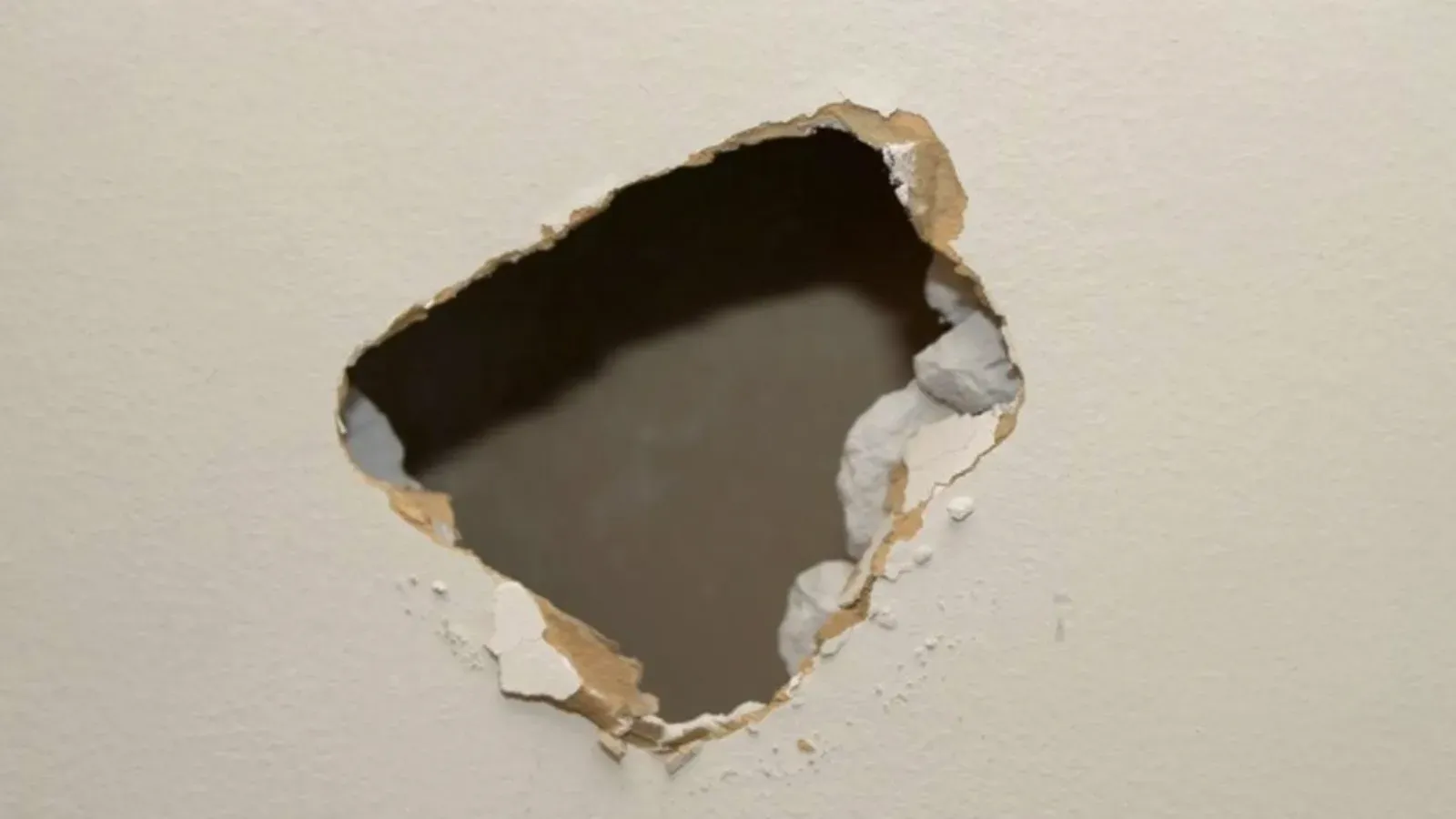
Signs you need this
- • A doorknob has punched a round hole through the wall behind a door that swings open too far
- • Wall anchors or screws for a shelf, TV mount, or curtain rod have pulled out and left a torn, crumbling hole
- • Dents, gouges, and scuffs from moving furniture, a bed frame, or a stroller banging the same corner over and over
- • A patch someone already tried that now shows as a raised, mismatched square that stands out worse than the original damage
- • A tenant is moving out and the walls are full of nail holes, anchor holes, and dents that have to be gone before the next lease
- • A homeowner is prepping to repaint or sell and wants every hole and dent gone so the fresh paint looks clean
The Difference Between a Fill and a Repair
Anyone can push compound into a hole. Making the hole disappear is the part that takes a drywall finisher. Lowell Quality Drywall & Plaster patches walls so the repair vanishes under paint instead of announcing itself as a raised square in the corner of the room. The two most common calls are a doorknob that has punched a clean round hole through a wall behind a door, and a shelf, TV mount, or curtain rod that has torn its anchors out and left a crumbling gap. Both look small. Both go wrong when they are filled instead of patched, because compound alone has nothing to grip and shrinks as it dries, leaving a dish or a crack right back where the hole was.
Backing, Plugs, and Why the Stick-On Disc Fails
A proper patch starts by cutting the torn paper and loose board back to something solid. A small hole gets a backed patch, a piece of board set behind the opening so the new compound has real support. A larger hole, anything from a fist up to a foot or more, gets a cut-in drywall plug: a clean square of new board fitted to the opening, set on backing, taped at the seams, and feathered wide with joint compound so the edges melt into the wall. The reason a hardware-store mesh disc so often shows through is that it sits on the surface with no backing and no feathering, so it telegraphs a bump and a ring the first time light rakes across it. FibaTape and a properly floated seam do the job the disc pretends to.
Rental Turnovers in a City That Runs on Them
More than sixty percent of Lowell’s housing is renter-occupied, and neighborhoods like Pawtucketville near UMass Lowell’s North Campus, The Acre, and Back Central turn units over constantly. A move-out wall is rarely one dramatic hole. It is thirty nail holes, four anchor holes, a row of dents behind a bed, and a scuffed corner where a couch went in and out. Lowell Quality Drywall & Plaster scopes a turnover as one job and prices it by the room, because ten holes on a single wall are quick together and the same ten scattered across an apartment are not. Getting a unit back to move-in condition fast is money for a landlord, since an empty unit between tenants is lost rent, and a clean, flat, primed wall is what lets the next lease start on schedule.
Matching Texture So the Patch Is Not an Island
A flat patch that is not texture-matched still fails, because it reads as a smooth spot in a wall that has a finish. Lowell’s walls run from smooth Level 4 and Level 5 drywall in renovated units to light orange peel and knockdown in mid-century work to hand-troweled plaster skim in the old triple-deckers and cottages. The repair is matched to whichever the wall carries, worked in USG Sheetrock or Gold Bond board and joint compound to the surrounding GA-214 finish level, then primed so the patch takes paint at the same sheen as the wall around it. A patch that is flat, matched, and primed disappears. One that skips the match or the primer flashes a dull spot the first time the room is painted, which is exactly the outcome the repair is meant to avoid.
Knowing When a Patch Is the Wrong Answer
Patching is the right call for impacts: holes, dents, gouges, and torn anchors. It is the wrong call for a crack that keeps coming back, because a recurring crack is the wall moving, and filling it just resets the clock on the next one. It is also the wrong call for a soft, stained, or sagging spot from a leak, where the board itself is compromised and needs to come out. Lowell Quality Drywall & Plaster says so on site rather than patching over a problem that will return, so the repair that gets done is the one that actually holds.
Materials & standards
Products & materials we use
- USG Sheetrock
- National Gypsum Gold Bond
- FibaTape
- joint compound
Standards & codes we work to
- Massachusetts State Building Code (780 CMR)
- GA-214 finish levels
- ASTM C1396
- MA Construction Supervisor License (CSL)
- MA Home Improvement Contractor (HIC) registration
What the terms mean
- backed patch
- cut-in drywall plug
- mud and tape
- feathering
- orange-peel and knockdown texture matching
- skim coat
- unit turnover
- corner bead
Options & variants
| Option | When it applies | Cost |
|---|---|---|
| Nail-hole and dent fill | Move-out and repaint prep with many small marks | Low cost, priced by the wall or room, not the hole |
| Single hole patch and blend | One doorknob, fist, or anchor hole | Low, single-visit |
| Cut-in drywall plug | A hole too big to fill, up to a foot or more across | Moderate, includes backing, tape, and feathering |
| Failed-patch redo | A previous patch that bulges or shows a seam | Moderate, sometimes more than a fresh patch |
| Texture-matched repair | Wall carries orange peel, knockdown, or a plaster skim | Adds a matching step to any of the above |
What affects cost
- • How many repairs there are: a whole rental unit of nail and anchor holes is priced by the room, while one hole is a quick single visit
- • The size of the hole, since anything larger than a fist needs backing and a cut-in drywall plug rather than a simple fill
- • Whether the wall has a texture that has to be matched, since a smooth wall blends faster than one with orange peel or an old plaster skim
- • Whether the wall is drywall or older lath and plaster, since a plaster patch is worked differently than a drywall one
- • Whether a previous bad patch has to be cut out and redone before the wall can be finished flat
What to expect
- 1
Walk the walls
Every hole, dent, and failed patch is noted, and for a turnover the whole unit is scoped at once.
- 2
Clean it up
Torn paper and crumbling edges are cut back to sound board so the patch has something solid to bond to.
- 3
Patch it right
Small holes are backed and filled, larger ones get a cut-in drywall plug on backing, taped and set.
- 4
Feather and match
The compound is feathered wide so the repair sits flat, and the surrounding texture is matched, not left as a smooth island.
- 5
Prime
The patch is primed so it takes paint the same as the wall around it, and does not flash a dull spot through the color.
- 6
Ready for paint
The wall is left flat, matched, and primed, ready for a painter or the homeowner to roll the finish coat.
When this isn’t the right call
- If the wall has a recurring crack that keeps coming back after every patch, drywall crack repair is the better fit.
- If the damage is a soft, stained, or sagging patch from a leak rather than an impact, water damage drywall repair is the better fit.
- If most of a room's walls or ceilings are being torn out for a remodel rather than spot-patched, drywall removal and demolition is the better fit.
Frequently asked questions
I have a doorknob hole behind my door. Can you make it disappear? +
Yes. A doorknob hole gets a backed patch or a cut-in drywall plug, taped and feathered flat, then texture-matched and primed so once the wall is painted the repair is not visible. Lowell Quality Drywall & Plaster also suggests a simple stop so the knob does not punch through again.
I'm turning over a rental near UMass Lowell. Can you do a whole unit of holes at once? +
Yes, and that is priced by the room rather than by the hole. Scoping a full Pawtucketville turnover in one visit is faster and cheaper per repair than calling about each mark separately, and it keeps the unit ready to lease.
A patch I tried myself looks worse than the hole. Can you fix it? +
Yes. A stick-on mesh disc or an over-mounded fill usually shows as a raised square. Lowell Quality Drywall & Plaster cuts the failed patch back to sound board, sets a proper backed repair, and feathers it wide so it sits flat instead of bulging.
How big a hole can you patch before it needs replacing? +
A hole up to a foot or more across is still a patch, using a cut-in drywall plug set on backing. It only becomes a section replacement when the damage runs across studs or the board around it is failing, and that is assessed on site.
Will the patch match my textured wall? +
Yes. Whether the wall has a light orange peel, a knockdown texture, or an older plaster skim, the repair is matched to it so it does not leave a smooth island in a textured field.
Do I have to repaint the whole wall after a patch? +
Not always. A primed, matched patch can sometimes be touched up if you have the original paint, but a wall with many repairs or a color that has faded usually looks best with the full wall repainted, since fresh paint over an old finish can flash.